
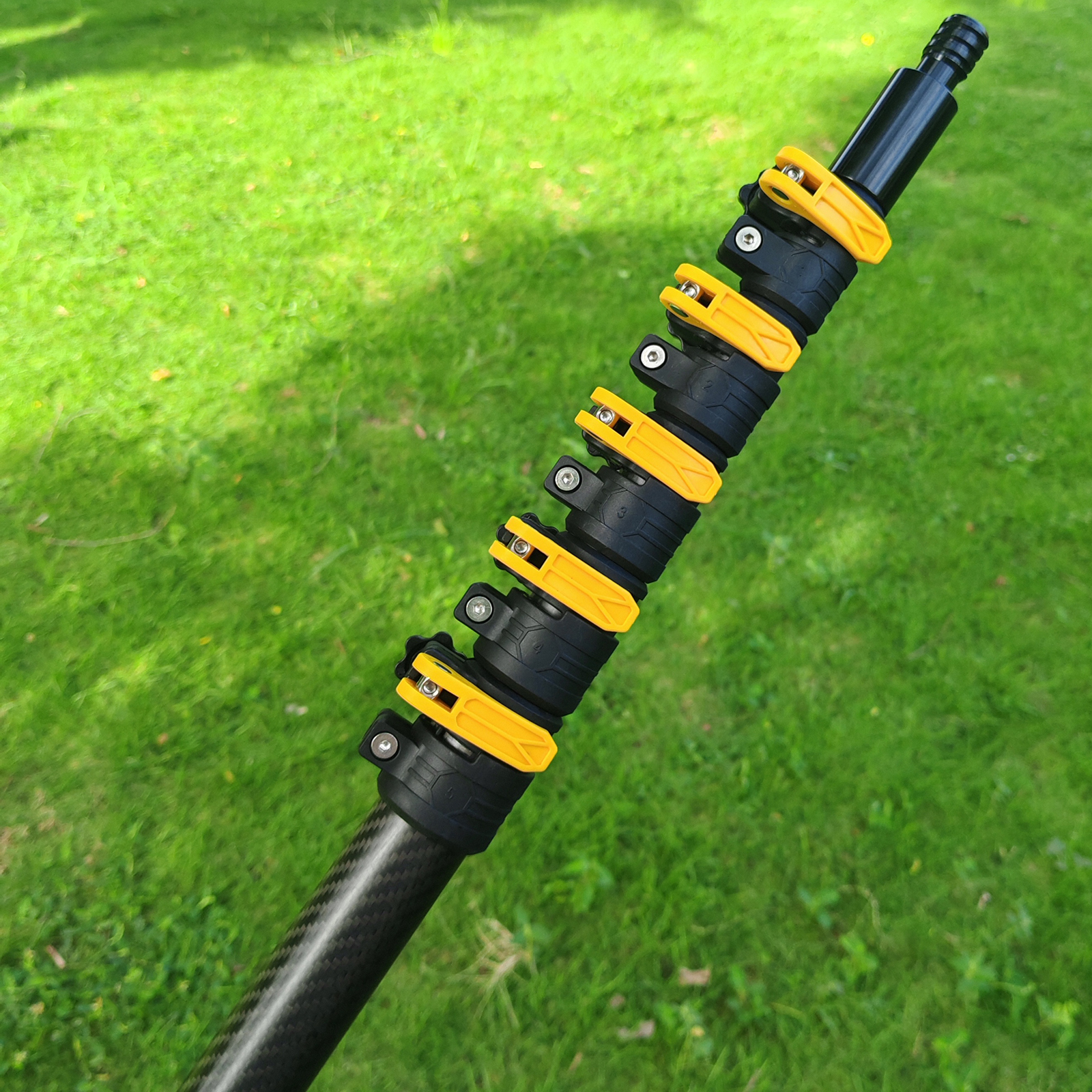
Selecting an extension pole seems straightforward until you are standing in a driveway trying to reach a second-story dormer window or a 30-foot commercial solar array. Buy a pole that is too short, and you are forced onto dangerous step ladders to bridge the gap. Buy one that is unnecessarily long, and you carry excess weight, struggle with storage, and pay for unused height.
When shopping for carbon fiber telescoping handles, navigating spec sheets requires understanding two crucial technical factors: Actual Extended Length vs. Max Working Reach and Tube Diameter Load Dynamics.
This guide breaks down the mechanics behind telescoping sizing to help you select the exact pole height for your application.
1. Extended Pole Length vs. Working Reach: The Math Explained
One of the most frequent mistakes homeowners and new contractors make is confusing physical pole length with functional working height. A pole specified as 18 feet does not mean your work stops at 18 feet.
Working Reach calculates the total height a person of average stature can comfortably work on while holding the pole at shoulder/chest level. The industry formula is simple:
For example, an 18 FT telescoping pole held by an operator standing 5'10" delivers an effective working reach of 24.5 feet. This allows complete coverage of standard US two-story residential rooflines, second-story window panes, and tall rain gutters without ever stepping off the ground.
-(5).jpg?w=1600&h=1600)
2. Tube Diameter, Section Overlap, and Load Capacity
A telescoping pole relies on concentric tubing—smaller inner sections sliding out from larger base sections. The mechanical rigidity and load capacity of any pole depend heavily on section diameters and internal segment overlap.
Base Tube Diameter Mechanics
Thicker base diameters provide high resistance to bending moments. As a rule of thumb, every extra section added to reach extreme heights (such as 40ft or 50ft) reduces the top section's diameter. A 50ft pole must taper down to thin upper segments, making it more flexible at top extension than a dedicated 18ft or 20ft pole with thicker wall profiles.
Safety Overlap Margin
To maintain structural integrity under heavy lateral loads (such as pressure washing or fruit picking), telescoping poles require minimum internal section overlap. Fully pulling out every section to its absolute physical stop reduces section engagement, increasing joint stress. Premium carbon fiber poles utilize pre-calibrated stop lines and heavy-duty flip-cam locks to preserve structural stiffness under maximum extension.
3. Length Matrix: 20ft, 30ft vs. 50ft Breakdown
| Pole Extended Length | Typical Working Reach | Best Applications | Target User / Environment |
| 18 FT – 20 FT | 24.5 FT – 26 FT | 2-story windows, single-family gutters, interior vaulted ceilings, holiday lights | Homeowners, Residential Painters, General Maintenance |
| 30 FT | 35.5 FT – 36.5 FT | 3-story residential facades, commercial solar panel banks, high tree trimming | Commercial Cleaners, Property Managers, Solar Technicians |
| 40 FT – 50 FT | 45.5 FT – 56.5 FT | Commercial window washing, industrial facility inspection, high-rise siding | Specialized Commercial Contractors, High-Reach Utility Crews |
4. Matching Length to Specific Application Requirements
Residential Home Maintenance (The 18ft–20ft Sweet Spot)
For 90% of single-family homeowners in the US, an 18 FT pole (providing up to 24.5 FT reach) is the optimal versatile length. It covers second-floor window washing, high interior wall painting, gutter debris removal, and roofline holiday lighting. Crucially, a collapsed length of around 4.7 feet allows easy storage in standard vehicle trunks or garage cabinets.
Commercial Solar & Window Washing (The 30ft Benchmark)
Solar panel arrays on steep residential roofs or ground-mount banks require a 30 FT pole. The added length allows technicians to maintain a safe 45-degree angle from the ground while sweeping water-fed brushes across panel rows without applying downward body weight.
Industrial Inspection & High-Rise Facility Care (40ft–50ft)
Ultra-long 40ft to 50ft carbon fiber poles replace expensive scaffolding in industrial settings. However, working at 50 feet requires specialized handling due to wind resistance and top-end lever forces, even with lightweight carbon fiber builds.
5. Storage, Transport, and Handling Considerations
Before purchasing an extension pole based purely on maximum height, consider transport logistics. A 50ft pole often collapses down to 6 or 7 feet, requiring roof racks or commercial vans. Conversely, an 18ft carbon fiber pole collapsing down to 4.7 feet fits sideways across a sedan backseat or small SUV trunk.
Always choose the minimum physical pole length required to comfortably reach your target working height. Excess sections add unnecessary base weight and handle thickness without providing additional utility.
Final Sizing Verdict
Choosing the correct carbon fiber pole length comes down to calculating your true working height requirement. For standard two-story home maintenance, an 18ft to 20ft pole delivers the ultimate balance of rigid control, light weight, and compact storage. For multi-story commercial work, stepping up to a 30ft or 50ft pole unlocks extreme reach without ladder hazards.
Explore full specifications and sizing options at the official CarbonFiberEver Extension Poles Collection.
-(7).jpg?w=1600&h=1600)