
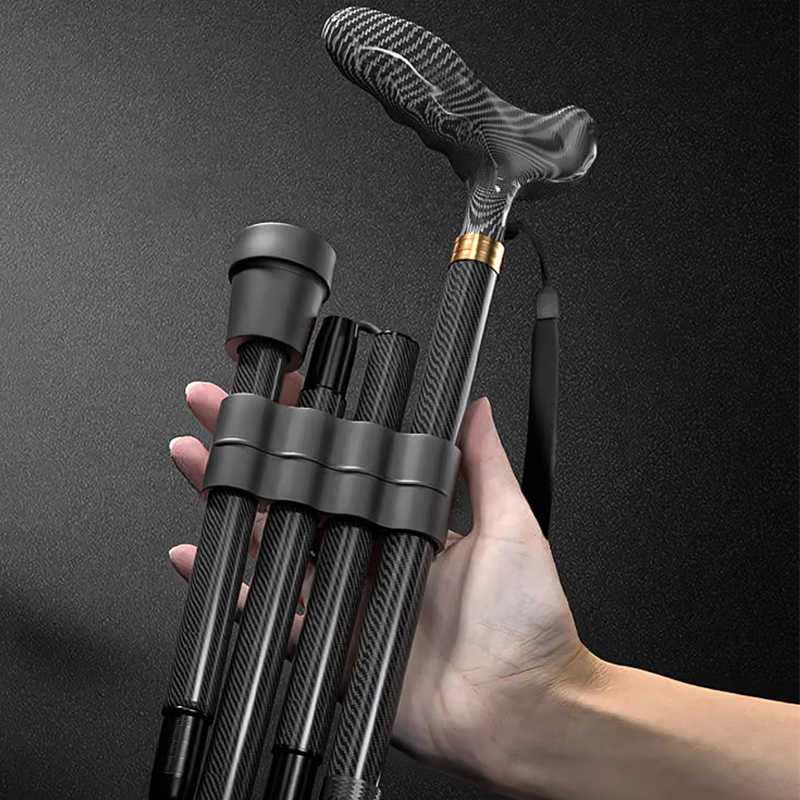
If you’ve been shopping for a walking cane online, you’ve likely noticed prices ranging anywhere from $15 to well over $100 for products that all claim to be "carbon fiber."
Here is the inconvenient truth of the online mobility market: a large percentage of budget "carbon fiber canes" sold on major marketplaces contain zero carbon fiber. Instead, they are basic aluminum tubes wrapped in a cheap hydro-dipped water transfer film or printed vinyl sticker that mimics the famous woven look.
While a printed aluminum cane might look decent in a low-resolution product photo, it delivers none of the structural integrity, vibration dampening, or ultralight performance of true composite materials. Worse, relying on a fake carbon cane when you need genuine load-bearing stability can lead to unexpected bends or structural failures.
Here is how you can spot a fake carbon fiber walking cane in under two minutes—and why real 3K carbon composite is worth every penny.

3 Quick Ways to Spot a Fake Carbon Fiber Cane
You don't need a materials testing lab to verify what your cane is actually made of. Real woven carbon composite leaves distinct physical signatures that cheap printing processes simply cannot replicate.
1. The 3D Light Reflex Test (Visual Depth)
Hold the cane shaft under a direct light source and rotate it slowly in your hand.
-
Real Woven Carbon (3K Weave): Real carbon fiber is made of thousands of micro-filaments woven in an alternating crosshatch pattern. As light sweeps across the surface, the weave reflects light dynamically. You will see a distinct 3D optical depth (holographic effect) where bright threads swap shadows as the angle changes.
-
Fake Printed Pattern: Hydro-dipped carbon patterns are flat, two-dimensional ink prints. The pattern remains completely static regardless of how you rotate the shaft under light. If the carbon "squares" look like a flat pixelated grid with zero depth, it is paint, not fiber.
2. The Tap Sound Test (Acoustic Resonance)
Gently tap the middle of the cane shaft with a small metallic object, such as a coin or a house key.
-
Real Carbon Composite: Resin-impregnated carbon fibers produce a distinct, high-frequency, crisp "ping" or firm click with minimal sustained vibration reverberation.
-
Fake Aluminum Tubing: An aluminum tube painted with carbon print will produce a lower, hollow metallic ringing sound or a deadened thud.
3. Inspecting the Seam and Wall Thickness
Look closely at the transition points—near the top handle collar or the rubber tip attachment point.
-
Real Carbon Composite: Carbon fiber tube walls are noticeably thick (typically 1.2mm to 1.5mm of dense structural fiber layers). The weave continues continuously around the cylinder without unnatural printed seams or pattern tearing.
-
Fake Printed Pattern: Cheap printed canes often show a visible "overlap seam" along one side of the shaft where the transfer film met during manufacturing. You may also see slight stretching or distortion of the carbon grid pattern near curved areas or pre-drilled adjustment holes.
Why Genuine 3K Carbon Fiber Costs More (And Why It Matters)
Manufacturing a real carbon fiber walking cane is a precision-engineered process, not a mass-stamping operation.
To achieve an ideal balance of structural strength and minimal weight, high-quality canes utilize rolled 3K carbon fiber tubing (T700 grade strands) infused with high-tensile epoxy resin. The carbon strands are wrapped under precise tension and cured under heat and pressure inside an autoclave.
1. True Weight Relief for Your Joints
A standard aluminum cane typically weighs between 350 to 500 grams. A fully real carbon fiber cane drops that weight down to around 180 to 240 grams (frequently lighter than an iPhone).
When walking thousands of steps a day, lifting an extra 200 grams on every single stride accumulates into pounds of drag on your wrist, elbow, and shoulder joints.
2. Natural Micro-Vibration Absorbing
Aluminum is a rigid conductor of kinetic energy. Every time a metal cane strikes hard concrete, the micro-impact shock travels straight up the metal shaft and transfers into your wrist and palm, contributing to joint fatigue and discomfort for users with arthritis.
Real carbon fiber composite naturally dissipates micro-vibrations through its layered strand structure, delivering a much smoother, cushioned feel at every footstep.
3. Superior Load Capacity Without Bending
Low-cost aluminum canes rely on thin tube walls to keep weight down. Under heavy downward load or accidental lateral strain (such as getting caught between sidewalk cracks), thin aluminum deforms or bends permanently.
High-grade 3K carbon tubing provides immense tensile strength—capable of supporting static downward pressures of 300 to 350+ lbs without flex or structural compromise.
Our Manufacturing Promise: Pure Carbon Composite
We believe in complete transparency. We don't hide behind misleading marketing terms like "carbon-style finish," "carbon composite alloy," or "carbon look."
Every carbon fiber cane in our collection features:
-
100% Real 3K Carbon Fiber Shafts: Precision-wrapped layers engineered for load-bearing strength and zero filler layers.
-
Verified Weight Benchmarks: Engineered to weigh under 230g for maximum joint relief.
-
Structural Safety Testing: Every batch undergoes vertical load compression testing to guarantee daily reliability.
🔎 Buying Advice: Before purchasing any cane advertised as "carbon fiber," check the product specifications closely. If the item description mentions Aluminum Alloy with Carbon Coating or fails to specify the carbon weave/weight, you are paying for painted metal.
Frequently Asked Questions
Is a real carbon fiber cane lighter than aluminum?
Yes. Genuine carbon fiber is roughly 40% to 50% lighter than standard aluminum mobility canes of the exact same dimensions, while offering higher tensile strength and better weight capacity.
Can carbon fiber walking canes break easily?
No. High-grade 3K carbon composite is extremely tough and designed to withstand high vertical compression loads. Unlike metal, which bends under pressure, carbon fiber retains its shape and structural integrity under heavy daily use.
How can I tell if a carbon cane on Amazon is genuine?
Look for specific structural details in the seller's description, such as "3K weave," "T700/T500 carbon," or exact weight specifications in grams. If the product price is under $20-$25, it is almost certainly a hydro-dipped aluminum cane.