
⚡️ Free Shipping ⚡️

Shopping Cart

Your cart is currently empty.

Continue shopping

  • Total $0.00 USD
Taxes and shipping calculated at checkout

Carbon Fiber vs. Aluminum Extension Poles: Which One Is Worth the Investment?

Aug 29, 2026 Carbon Fiber Ever
carbon fiber vs aluminum extension pole

When working at heights above 15 feet, standard ladders introduce unnecessary fall risks. Telescoping extension poles have long been the practical alternative for home maintenance, commercial window washing, and gutter clearing across North America. However, anyone who has spent an hour painting an exterior gable or pressure washing high siding with a fully extended 18-foot metal pole knows the struggle: violent pole flex, uncontrollable sway, and acute shoulder strain.

For decades, aluminum has been the default material for high-reach extension handles due to its low production cost. But as carbon composite technology shifted from aerospace down to commercial equipment, 3K carbon fiber extension poles have gained major traction.

carbon fiber extension pole

This guide breaks down the physical differences between carbon fiber and aluminum extension poles to evaluate whether upgrading to carbon fiber pays off for your projects.

1. Rigidity & Mechanical Deflection: Stopping the "Noodle Effect"

The primary flaw of aluminum extension poles at lengths over 12 feet is low flexural modulus. Aluminum alloys bend easily under lateral load. When a heavy paint roller, squeegee, or gutter scoop is attached to the tip of an extended 18-foot aluminum pole, the pole sags downward into a severe arc.

This sag forces the user to apply constant leverage just to hold the attachment against the surface. Pushing upward on a flexed pole creates an unstable spring-back effect, making precise work like window cleaning or trim painting difficult and tiring.

In contrast, high-tensile 3K carbon fiber possesses a modulus of elasticity up to five times greater than structural aluminum. At full extension, a carbon fiber rod experiences minimal flex, staying straight under working load. This rigidity delivers three distinct advantages:

  • Direct Force Transfer: Every ounce of pressure applied at the base travels straight to the attachment head without wasting energy bending the pole.

  • Pinpoint Accuracy: No sweeping sway when maneuvering around delicate roof tiles, window frames, or holiday light hooks.

  • Safety Control: Eliminates sudden recoil when lifting tools off high surfaces.

2. Weight & Musculoskeletal Fatigue (Overhead Ergonomics)

Working overhead requires static muscular contraction of the shoulders, upper back, and forearms. According to OSHA ergonomic assessments, repetitive overhead force with tools weighing over 3 lbs significantly accelerates fatigue and increases the risk of rotator cuff strain.

Physics Fact: The Lever Arm Principle

Weight at the tip of an extension pole is multiplied by its extended length. A pole weighing 4 lbs at ground level exerts substantially higher turning force (torque) on your lower back when held at a 60-degree angle than a 2.5 lb pole. Dropping just 1 to 1.5 lbs from the pole structure dramatically cuts physical strain over a full workday.

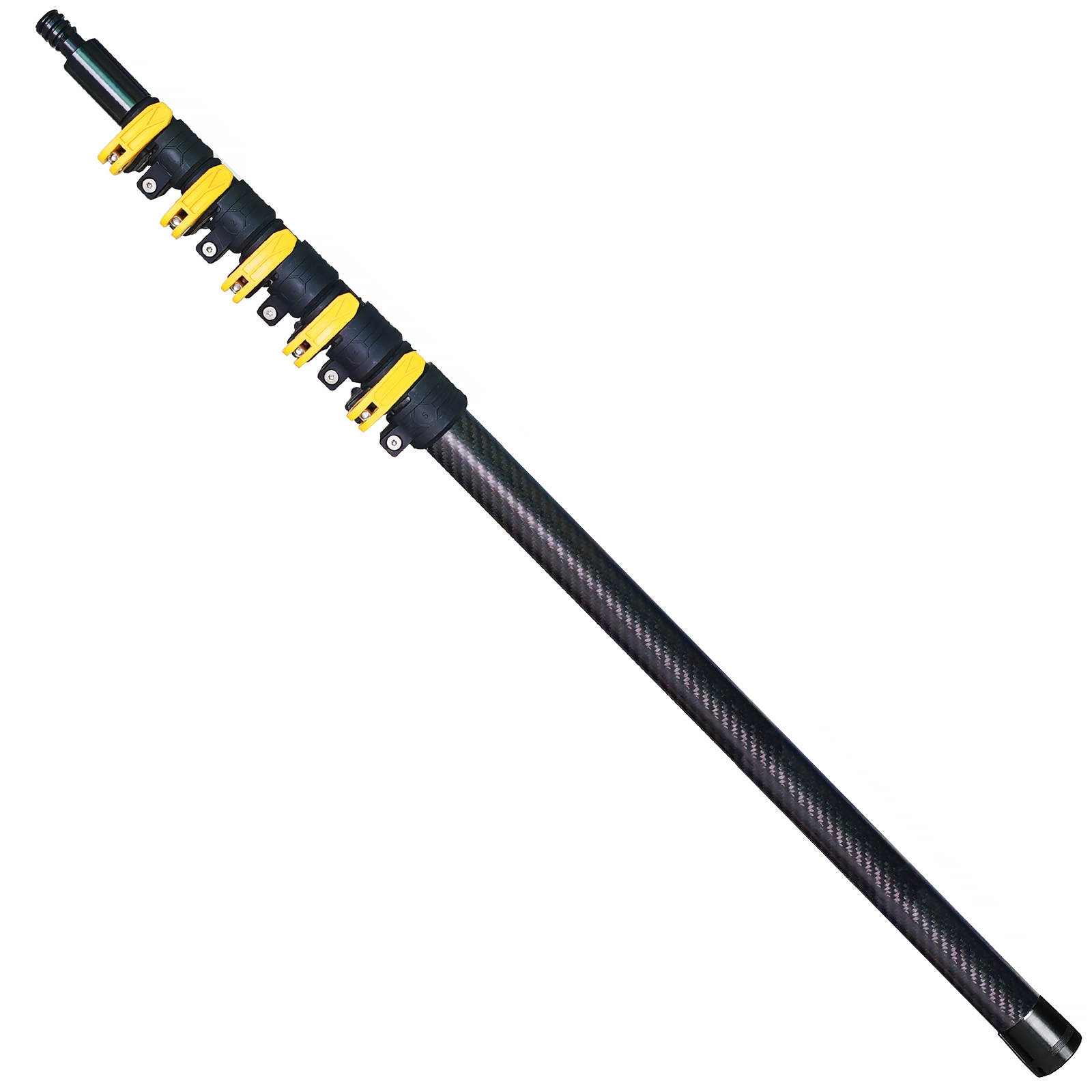
Engineered carbon fiber composite poles are roughly 30% lighter than standard aluminum poles of equal wall thickness. For instance, a professional-grade 18 FT Carbon Fiber Telescopic Extension Pole weighs just 2.56 lbs (1.16 kg). Replacing heavy metal poles with carbon fiber lowers fatigue, allowing homeowners and field crews to complete projects faster with fewer rest breaks.
18 FT Carbon Fiber Telescopic Extension Pole

3. Head-to-Head Comparison: Aluminum vs. Carbon Fiber

The table below highlights key performance metrics between standard aluminum extension poles and modern 3K carbon fiber alternatives:

Performance Metric Standard Aluminum Pole 3K Carbon Fiber Pole
Rigidity at 18 FT+ High deflection (bends easily under weight) Ultra-rigid (wobble-free straight line)
Average Unit Weight 3.8 lbs – 5.2 lbs 2.56 lbs (30% weight reduction)
Locking System Twist-locks (prone to internal slippage) Heavy-duty quick-release flip-cam locks
Denting & Deformation Dents easily when dropped; bent sections jam High impact resistance; zero permanent bending
Corrosion & Rust Oxidizes over time; locks seize up 100% rust-proof carbon weave matrix
Electrical Conductivity Conductive (hazard near power lines) Conductive (requires distance from power lines)
 

4. Locking Mechanisms & Field Durability

A pole's material strength matters little if its locking mechanisms fail. Most budget aluminum poles rely on internal plastic expansion plugs (twist locks). After exposure to grit, paint drips, or repeated tightening, internal twist locks begin to slip under downward pressure, causing the pole to unexpectedly collapse mid-job.

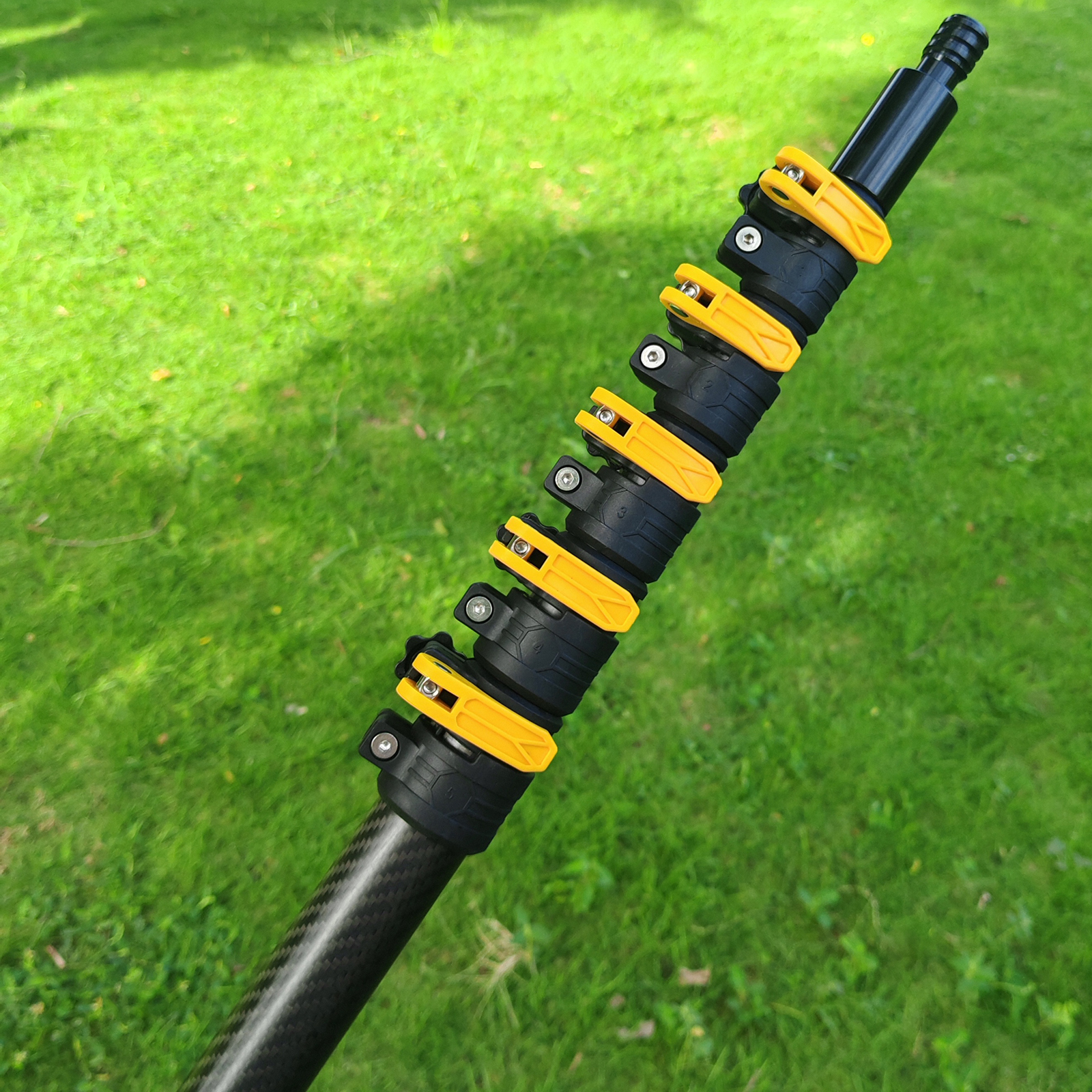
Higher-tier carbon fiber extension systems utilize external heavy-duty flip-cam lever locks. These industrial clamp locks provide positive visual confirmation of locking force. They clamp securely down on the outer diameter of each segment, preventing section collapse even when applying heavy upward pressure during roof debris clearing or window scrubbing.

Additionally, aluminum poles retain permanent dents if dropped onto concrete or against truck beds. A single small dent on an aluminum tube often prevents that segment from retracting. Carbon composite walls rebound from impacts without permanent dimensional distortion.

5. Attachment Compatibility & All-Season Utility

To maximize return on investment, an extension pole should not sit idle in a garage for eleven months out of the year. Versatility depends on tip thread standards. Using a universal 3/4" ACME metal threaded tip ensures compatibility with 95% of North American commercial attachments:

  • Spring Maintenance: Interior vaulted ceiling painting and high exterior siding touch-ups using standard paint rollers.

  • Summer Care: Attaching squeegees, water-fed brushes, and solar panel cleaning heads.

  • Autumn Work: Clearing leaves from gutters and high roof edges with angled scoops.

  • Winter Preparation: Hanging outdoor holiday lights safely from ground level using specialized light hooks.

With a 4.7 FT collapsed length, an 18-foot pole easily fits inside a car trunk, SUV cargo area, or utility closet, avoiding the transportation hassle of rigid ladders or long single-piece poles.

Is Carbon Fiber Worth the Investment?

If your high-reach projects are limited to occasional indoor 8-foot ceiling dusting, an inexpensive aluminum pole suffices. However, for continuous outdoor maintenance, second-story window washing, exterior painting, or roof clearing, a 3K carbon fiber extension pole is the superior tool.

By eliminating ladder safety risks, preventing shoulder fatigue, and delivering a rigid, wobble-free reach up to 24.5 feet, carbon fiber poles pay for themselves in labor efficiency and long-term durability.

Explore the complete collection of high-reach composite gear at the official CarbonFiberEver Extension Poles Collection.

Back to the blog title

Post comment

Please note, comments need to be approved before they are published.