
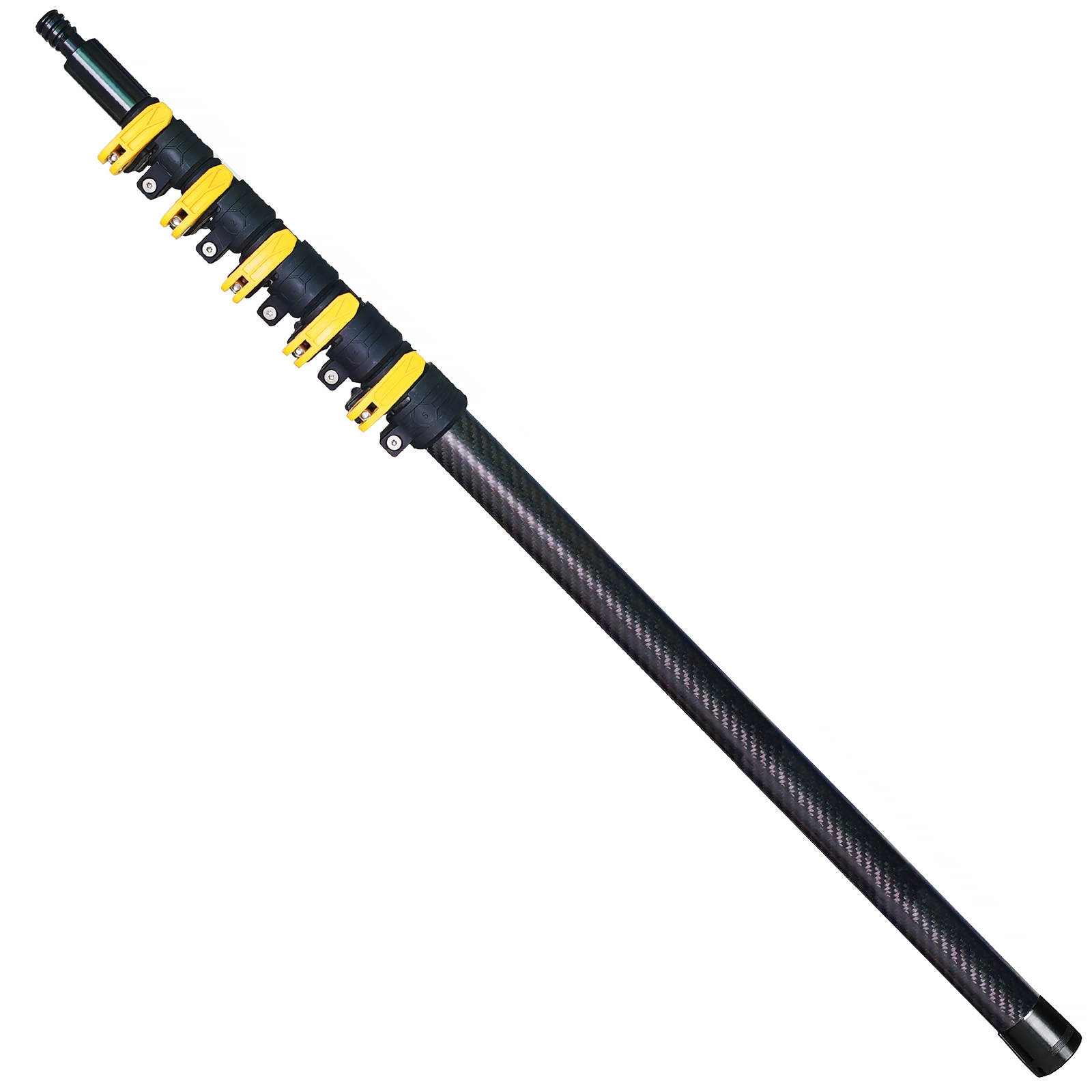
When shopping for high-reach commercial telescoping poles, you will encounter various material labels: 100% Carbon Fiber, 3K Carbon Fiber Weave, and Hybrid Composite (Carbon-Fiberglass blend).
While these terms are often thrown around interchangeably in marketing brochures, they represent distinct manufacturing techniques, wall laminations, and performance characteristics. Choosing the right composite breakdown directly impacts tube flex, weight distribution, fatigue resistance, and overall equipment longevity.
Here is a technical breakdown of how composite materials differ and how to select the right mast structure for your job.
1. Material Science Breakdown: What Each Term Means
A. What is 3K Carbon Fiber?
The "K" in composite terminology stands for Kilo (1,000). A "3K" rating means that each woven fiber tow (bundle) contains exactly 3,000 individual carbon filaments.
-
The Weave Pattern: These 3,000-filament bundles are woven in a criss-cross pattern (typically 2x2 twill or plain weave) forming the visible signature "checkerboard" surface.
-
Structural Benefit: While inner layers provide longitudinal stiffness, the outer 3K woven layer provides exceptional hoop strength (crush resistance under clamping pressure) and superior resistance to surface abrasion and impact cracking.
B. What is 100% Full Carbon Fiber (Unidirectional / UD)?
"Full Carbon Fiber" means every structural layer in the pole wall—from the inner diameter to the outer sheath—is constructed exclusively from carbon fiber filaments (no glass fiber filler layers).
-
Unidirectional Alignment: Most layers run parallel along the length of the pole (0 degrees) to maximize flexural modulus (stiffness against bending).
-
Structural Benefit: Full carbon poles offer the ultimate strength-to-weight ratio, allowing maximum extension lengths with zero "noodle flex."
C. What is a Hybrid Composite (Carbon + Fiberglass)?
Hybrid composite tubing laminates layers of carbon fiber with layers of woven Glass Fiber (Fiberglass).
-
Structural Benefit: Fiberglass is denser and more flexible than carbon fiber. By sandwiching fiberglass inner layers beneath a carbon outer layer, manufacturers create an economical pole that offers moderate rigidity at a lower price point, albeit at the expense of added weight and increased lateral flex at high extensions.
2. Technical Material Comparison
3. How Modulus & Weave Impact High-Reach Extension
The primary performance metric for high-reach tools is Flexural Modulus (measured in Gigapascals, GPa), which dictates how rigid a tube remains under lateral pressure.
-
Deflection Control: As a pole extends past 18 feet, leverage multiplies the effect of gravity on the top section. High-modulus full carbon fiber resists sagging, keeping the pole straight.
-
Clamping Safety: Industrial telescoping poles use heavy-duty flip-cam locks. Pure unidirectional tubes can crack axially under high clamp compression over time. Adding a 3K woven outer layer distributes clamp pressure evenly around the circumference, preventing micro-fractures.
4. Selecting the Right Composite for Your Application
Commercial Inspection, Painting, & Multi-Tool Tasks
For tasks requiring continuous overhead movement—such as high-wall painting, roof photography, and gutter clearing—weight and stiffness are paramount.
The 18 FT Carbon Fiber Telescopic Extension Pole utilizes premium 3K Carbon Fiber construction. Weighing just 2.56 lbs, its rigid wall construction eliminates "noodle flex" when applying pressure against walls or roofs, while the 3K weave ensures long-term clamp durability.
-(7).jpg?w=1600&h=1600)
Heavy-Duty Water-Fed Overhead Scrubbing
When supporting water-filled supply hoses and wide brush heads up to 30 feet high, wall rigidity is critical.
Commercial systems like the 30 FT Reach Carbon Fiber Water Fed Cleaning Kit employ full commercial-grade carbon composite tubing. This stiffness enables operators to transfer downward scrubbing force smoothly across window glass and solar panels from the ground without lateral sway.
.jpg?w=1600&h=1600)
Summary: Making the Right Composite Investment
-
Choose Hybrid Composites for entry-level, low-reach tasks under 15 feet where weight is less critical.
-
Choose 100% Full Carbon Fiber for maximum height extension where minimal tube weight is necessary.
-
Choose 3K Woven Carbon Fiber for professional-grade tools that require the ultimate balance of light weight, maximum wall stiffness, and crush-resistant clamping durability.
Upgrade your job site equipment today with the CarbonFiberEver Extension Poles Collection.